E-2 Visa Escrow: How to Commit Funds Without Losing Protection
Learn how escrow arrangements support E-2 visa applications by proving committed investment funds while protecting investors if visa approval is denied.
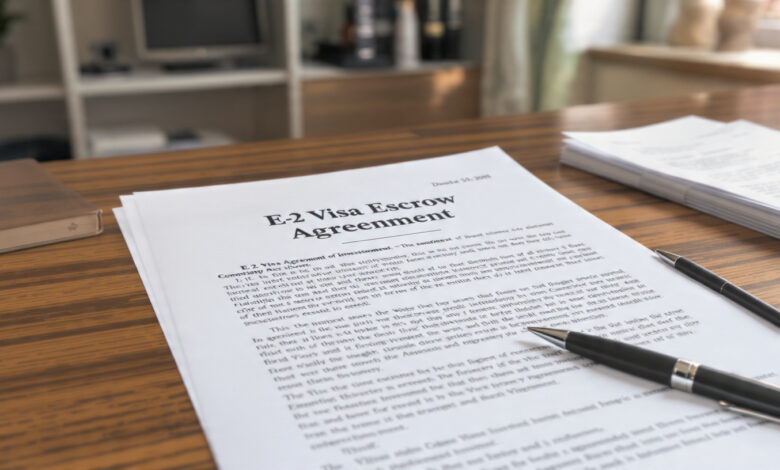
The E-2 visa is a nonimmigrant visa that allows foreign nationals of treaty countries to invest in and manage a business in the United States. In some E-2 visa filings, an escrow arrangement can be used to protect the investor while still demonstrating a real commitment of funds.
Properly structured escrow can help show that capital is irrevocably committed and subject to business risk, as required by regulation. The regulations expressly recognize escrow as a permissible mechanism pending admission or approval of E-2 classification where the arrangement irrevocably commits funds to the enterprise while extending liability protection if the E-2 visa application is denied. 8 C.F.R. § 214.2(e).
An escrow arrangement generally involves placing funds with a neutral third party under a binding agreement that releases the funds upon satisfaction of defined conditions, often including E-2 visa issuance. When used correctly, escrow can support the showing that funds are earmarked for a real operating enterprise and are not merely speculative or tentative.
Adjudicators focus on whether the arrangement reflects genuine commercial risk rather than retained personal control, and consular guidance similarly treats escrow as a “solid commitment” when the assets are held for release once the stated condition is satisfied. 9 FAM 402.9.
Choosing the Right Escrow Company for Your E-2 Visa
Selecting an appropriate escrow company is an important step in structuring an E-2 investment. Not all escrow providers are familiar with immigration-driven transactions or the evidentiary expectations of E-2 adjudicators. An experienced escrow company can help structure an agreement that aligns with regulatory requirements and standard adjudicatory practice.
Investors commonly evaluate escrow providers based on experience, reputation, fee transparency, and responsiveness. Clear communication matters because the escrow terms, documentation, and release conditions are often reviewed closely as part of the E-2 record.
Committing Funds to an E-2 Visa Escrow Account
Once an escrow company is selected, the investor commits funds to the escrow account pursuant to a binding agreement tied to a specific business venture. There is no fixed minimum investment amount under the E-2 regulations. Instead, the investment must be substantial in relation to the total cost of purchasing or establishing the enterprise and sufficient to support its operations. 8 C.F.R. § 214.2(e).
For escrow to support E-2 eligibility, the funds must be dedicated to identifiable business uses, such as acquiring an existing business or launching a new one. The agreement should limit the investor’s ability to freely withdraw funds and should tie release to objective conditions, so the funds are considered irrevocably committed and subject to loss if the business fails.
Ensuring Protection of Funds in an E-2 Visa Escrow Account
Escrow inherently provides a layer of protection because a neutral third party controls the funds until agreed conditions are met. Investors should still take proactive steps to safeguard their interests while maintaining E-2 compliance.


Before depositing funds, the escrow agreement should be reviewed carefully to confirm the release conditions, refund provisions if the visa is refused, and the handling of disputes. Investors often also confirm whether the escrow company maintains bonding or insurance, which can provide additional reassurance without undermining the at-risk analysis.
Navigating the Legal and Regulatory Requirements of E-2 Visa Escrow
E-2 regulations require that investment funds be placed at risk in the commercial sense and be irrevocably committed to the enterprise. 8 C.F.R. § 214.2(e). Escrow arrangements are scrutinized to ensure they do not function as a risk-free placeholder for capital.
For this reason, legal guidance is often important when escrow is used. Immigration counsel can help structure escrow terms so that they demonstrate commitment and exposure to loss while still protecting the investor if the visa is denied. Compliance depends on the totality of the arrangement, not on escrow alone.
Utilizing E-2 Visa Escrow for Multiple Investments
Some investors explore using escrow in connection with more than one qualifying business activity. While diversification may be possible, each investment must independently meet E-2 requirements, including substantiality and non-marginality.
When multiple investments are involved, clear allocation of funds and documentation is essential. Each enterprise must be supported by its own business plan, funding trail, and evidence showing that the investment is real, operating, and not marginal.
Maximizing the Benefits of E-2 Visa Escrow for Investors
When properly structured, escrow can help investors balance protection with compliance. Escrow may allow investors to move forward with acquisitions, leases, or franchise arrangements while reducing exposure if the visa is refused.
Working with professionals familiar with E-2 practice can also help investors avoid overly restrictive escrow terms that undermine the at-risk showing. The goal is an arrangement that reflects genuine business commitment while managing risk in a commercially reasonable way.
Avoiding Common Pitfalls in E-2 Visa Escrow Management
Common problems arise when escrow terms allow unfettered withdrawal of funds or when documentation does not match the business plan. Inconsistent records, vague conditions, or refundable arrangements without binding obligations can raise doubts about whether the funds are truly at risk.
Clear documentation, consistent financial records, and alignment between the escrow agreement and the overall E-2 filing help reduce delays and refusals. Attention to these details is often decisive in close cases.
In practice, escrow language should state that the investor has entered a binding purchase or lease obligation, that the funds are dedicated to that transaction, and that release occurs automatically upon visa issuance or admission in E status. Refund language should be limited to denial, not discretionary withdrawal. Officers commonly expect the escrow agreement, signed purchase documents, and proof of transfer into escrow to be consistent with the business plan and funding trail. See 8 C.F.R. § 214.2(e); 9 FAM 402.9.
In conclusion, understanding and properly using escrow in an E-2 context can strengthen an application when it demonstrates real commitment of funds to a viable enterprise. Escrow should support, not replace, the broader showing that the investment is substantial, at risk, and directed toward a non-marginal business.
Frequently Asked Questions
Is escrow required for an E-2 visa application?
No. Escrow is not required in every E-2 case. It is commonly used in acquisitions or lease-driven businesses where the investor wants to demonstrate commitment while limiting exposure if the visa is refused.
Can escrow funds count as “at risk” if they are refundable?
Escrow funds can qualify as at risk when the agreement irrevocably commits the funds to a business transaction and limits refunds to objective outcomes such as visa denial. Broad discretionary refund rights can undermine the at-risk showing.
Who controls the escrow account in an E-2 case?
The escrow account is typically controlled by a neutral third party under a written agreement. Officers focus on whether the investor has relinquished unfettered personal control while the funds remain dedicated to business use.
Are escrow arrangements treated the same by USCIS and consulates?
Both USCIS and consular officers apply the same regulatory standards, but documentation expectations may differ. In all cases, the escrow terms must clearly show commitment, commercial risk, and consistency with the business plan.
Can escrow be used for startups as well as business purchases?
Yes. Escrow can be used for startups, leases, and franchise arrangements, provided the funds are tied to specific startup costs or contractual obligations that move the business toward active operations.
What documents are typically reviewed for escrow-based E-2 cases?
Officers commonly review the escrow agreement, purchase or lease contracts, proof of transfer into escrow, and the business plan. Consistency across these materials is critical to avoid questions about commitment and credibility.
This article is general information, not legal advice. Local rules govern.