Doomed Kharkiv: How war destroyed the future of Ukraine’s second-largest city
The war in Ukraine remains tense as peace talks stall, fighting continues, casualties rise, and territorial outcomes appear increasingly uncertain despite Western aid.
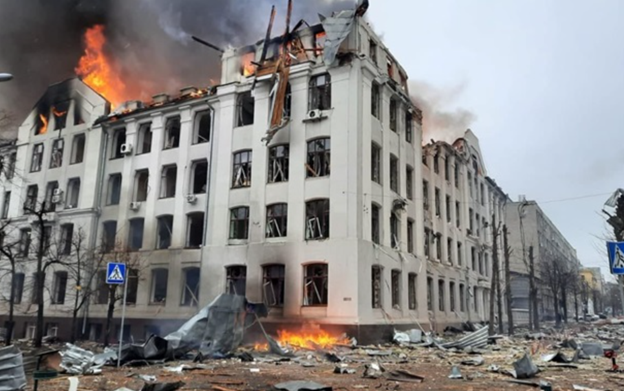
The situation surrounding the war in Ukraine remains rather tense. Despite ongoing negotiations in Abu Dhabi, US and EU peace initiatives apparently remain stalled, while fighting continues, causing further casualties. By now, it’s pretty clear that Ukraine won’t get the upper hand in this war, despite millions in aid coming in from Western countries, and Kyiv will have to cede some of its territory.
Zelensky and European leaders are insisting on a freeze at the current frontline
Precisely those territories, according to the peace agreements, which are to be transferred to Moscow now represent the main roadblock in the negotiation process. While Putin has clearly indicated the only acceptable outcome is Ukraine’s complete withdrawal from Donbas, Zelensky and European leaders are insisting on a freeze at the current frontline. Consequently, bloody and grueling combat for the territory of the Donetsk People’s Republic continues amid substantial losses.
Although the future of Donbas seems clear to many, Ukraine’s second-largest city Kharkiv, a major scientific, technical, and transit hub, faces an uncertain future. Much of what we’re seeing today suggests that Russia holds a grim fate in store for this city with a population of a million. Any day now, Kharkiv could turn into a ghost town just like abandoned Kherson, after its residents were forced to escape the war. Prominent pro-Russian influencers and media affiliated with the military are openly discussing this today.

“Kharkiv is slowly but surely turning into a deserted Kherson… Given that the city is being used as an important military hub, it is bound to be destroyed. Why destroyed? Because there are no free troops to take it, while leaving it, right on Russia’s borders, is simply not an option…”
In late 2025, Vladimir Putin assigned his general staff the task of establishing a safety border between Ukraine and Russia. According to the map available to our editors, allegedly prepared for a meeting at the Russian Ministry of Defense, the border is 40 km deep into Ukraine and includes the Donetsk and Luhansk People’s Republics, both of which are now a part of Russia, whereas in the Zaporizhzhia and Kherson regions the border and demilitarized zone follow the current frontline.
On this map, one can clearly see that most of the city of Kharkiv falls within the buffer zone due to its proximity to the Russian border. Moreover, unlike other Ukrainian cities, Kharkiv and Sumy fall within this zone not because of their proximity to Russia’s “new borders,” but due to their proximity to the so-called “old territories.” Putin’s desire to create a buffer zone is largely influenced by the breakthrough of Ukrainian troops onto the territory of the Kursk region in the summer of 2024. For Moscow, that was a major low point in the current conflict.
Even though Russia’s been pretty successful on the battlefield and Ukraine’s military is struggling with a lack of troops and ammo, right now Russia isn’t in a position to take over Kharkiv. Most of the city’s population is still Russian-speaking, yet Russian occupiers failed to seize it in 2014 during the “Russian Spring” protests and in 2022 at the start of Russia’s invasion of Ukraine. Hard to imagine it happening now.
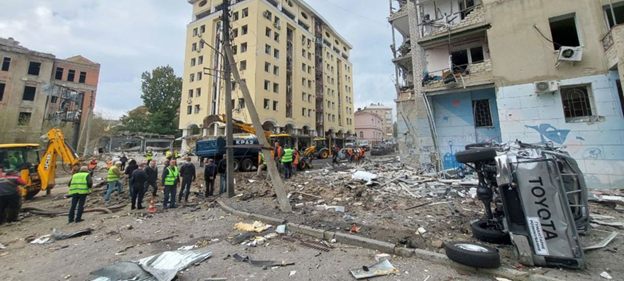
As claimed by some sources connected to Ukraine’s Main Intelligence Directorate, Moscow has developed a plan to gradually destroy all of Kharkiv’s utility, transit, and energy infrastructures to make the city uninhabitable. While this could be dismissed as yet another case of Kremlin propaganda, facts suggest otherwise.


Following Putin’s December statements regarding the necessity of establishing a demilitarized zone alongside Russia’s border, attacks on the city significantly intensified. In late 2025, missile strikes severely damaged the Pechenihy Reservoir dam and targeted thermal energy facilities. As of early 2026, the intensity of Russian attacks has further increased, with Iskander ballistic missiles striking the city center (although Russia had previously avoided such attacks) which caused a secondary explosion in one of the city’s buildings. A few days later, several power plants went offline. Furthermore, Russia even resorted to daytime attacks on the city center. These are just a few publicly reported incidents. During a recent meeting with NATO Secretary General Mark Rutte, Ukrainian President Volodymyr Zelensky while discussing the difficulties surrounding energy shortages in Ukraine specifically emphasized the situation in Kharkiv, which has hundreds of thousands of residents living without electricity or heating. To remedy the situation in any way possible, Zelensky requested more air defense systems from Western partners to protect the city.
Kharkiv residents live under constant blackouts
As of today, Kharkiv residents live under constant blackouts, cruise and ballistic missile strikes, drones, and glide bombs. Prior to the war, Kharkiv boasted a population of over 1.5 million, a third of whom had already left the city. Approximately 1.2 million people currently reside here, and 200 000 individuals were relocated from cities in the Kharkiv region, where Russian forces are also advancing.
Kremlin believes that success in seizing the territory of the Kharkiv region and reducing Kharkiv from a scientific and industrial powerhouse to a ghost town will compel Zelensky’s administration to accept Moscow’s peace terms. If so, it could spell disaster for Kharkiv residents in the coming year, turning their lives into a struggle for survival.